Plants Can Be the Doorways to Creating a Sacred Relationship with the Earth | Pachamama Alliance http://ow.ly/LMLbZ
Archive for Uncategorized
A Trade Rule that Makes It Illegal to Fa
A Trade Rule that Makes It Illegal to Favor Local Business? Newest Leak Shows TPP Would Do That And More by David Korten — YES! Magazine http://ow.ly/LMyfT
10 Top Foods That Might be Causing Cance
10 Top Foods That Might be Causing Cancer – Bulletin Daily News – Bulletin Daily News http://ow.ly/LLY2l
The Big Answer to Wrangling Oil Spills C
The Big Answer to Wrangling Oil Spills Could Be in This Tiny Mesh | TakePart http://ow.ly/LLXHd
How to Save Tomato Seeds – Organic Garde
How to Save Tomato Seeds – Organic Gardening – MOTHER EARTH NEWS http://ow.ly/LLXsm
Checking out the new #Hootlet! http://ow
Checking out the new #Hootlet! http://ow.ly/LLX2d
Glass Roofing Tiles Collect Heat To Warm Homes


SolTech Energy, a Swedish company selling solutions for clean solar power, has developed a unique home heating system contained within roofing tiles made out of ordinary transparent glass. The attractive house-warming tiles (somewhat ironically) give roofs a beautiful, icy appearance quite unlike anything else we’ve ever seen before.
In 2009, the SolTech Energy System was selected by a jury and nominated among nine as the year’s “Hottest New Material.” Based on votes by the people, the company’s glass tiles were awarded with a gold medal from the North Building Fair, Nordbygg. “The winning entry combines an attractive design with essential functions for clean and sustainable energy. It is an innovative product that is well in time,“ said the chairman of the jury, PhD. Bengt Toolanen.
So what makes the system so special and award worthy? For starters, the tiles are made from ordinary glass and have about the same weight…
View original post 181 more words
Your ecological footprint – what?!
Our environmental footprint is a very important standard each of needs to be aware of as it relates to our communities. Each of us individually can do a little bit to help, the best that can happen is that we gather people in our community to help each other to make our environmental footprint sustainable.

 I could start with the typical “save the earth, it is the only we have”, which is completely true, but I will start to tell you that we, as humans need to stop acting like the planet is infinite and it is never going to run out of resources, if not for the earth we share, for ourselves. It will. It is already… And still, it passes us by like it is nothing. Why? Because we don’t see it truly in front of us. If we see war, we see dead people, we see injured people, we know it is happening, we know we need to do something. We don’t see the impact of our actions in our planet, at least clearly. But it is happening.
Yesterday, according to the Global Footprint Network, was the Earth Overshoot Day. For those of you who are not familiar with this, the…
View original post 225 more words
Is the Anthropocene a world of hope or a world of hurt?
Great discussion that got me to do a little more research!
Neonicotinoid Pesticides Are Bad News For Everything
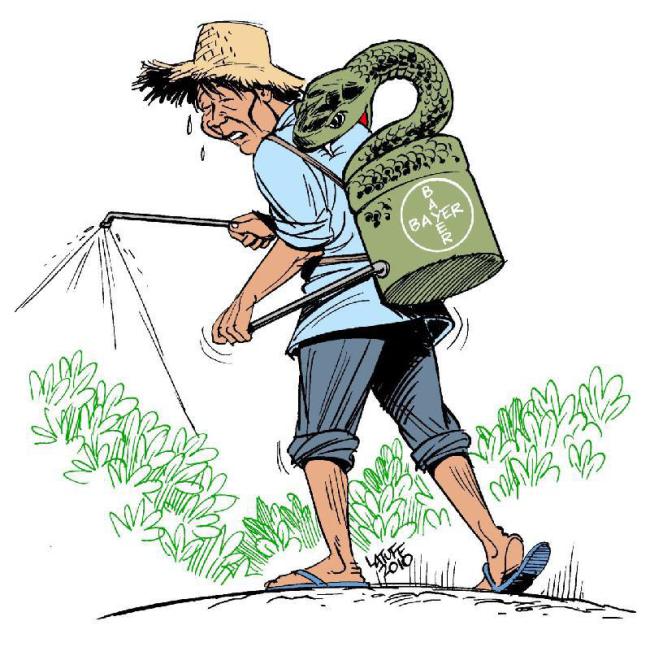
It’s not just the bees and their ilk. Neonicotinoid insecticides were known to harm important pollinators, and now a major report says they are killing insects, microbes, lizards, earthworms, birds and even coastal shellfish.
Neonicotinoids make up almost one-third of insecticides used. In 2011 the International Union for Conservation of Nature set up a task force to review the safety of systemic pesticides. After reviewing over 800 studies the group now says present use “is not sustainable”, and calls for a global phase-out.
The chemicals break down more slowly than early tests suggested, says author Jeroen van der Sluijs of Utrecht University in the Netherlands. These past studies, which informed the decision to allow the use of neonicotinoids, looked mostly at immediate effects. But long-term environmental build-up may be the real problem, so the task force says the previous regulatory studies “lack environmental relevance”.
View original post 151 more words
 Benjamin Visuals LLC
 Barry Benjamin Web site
You must be logged in to post a comment.